Common Challenges in Planning product inspections in China
Inspection failures often begin before the factory visit: product revisions are unclear, criteria are subjective, goods are not ready, the sample is unrepresentative, or nobody owns a shipment hold. Buyers can prevent avoidable rework by planning the decision, evidence, contacts, and corrective-action path before booking the inspection.
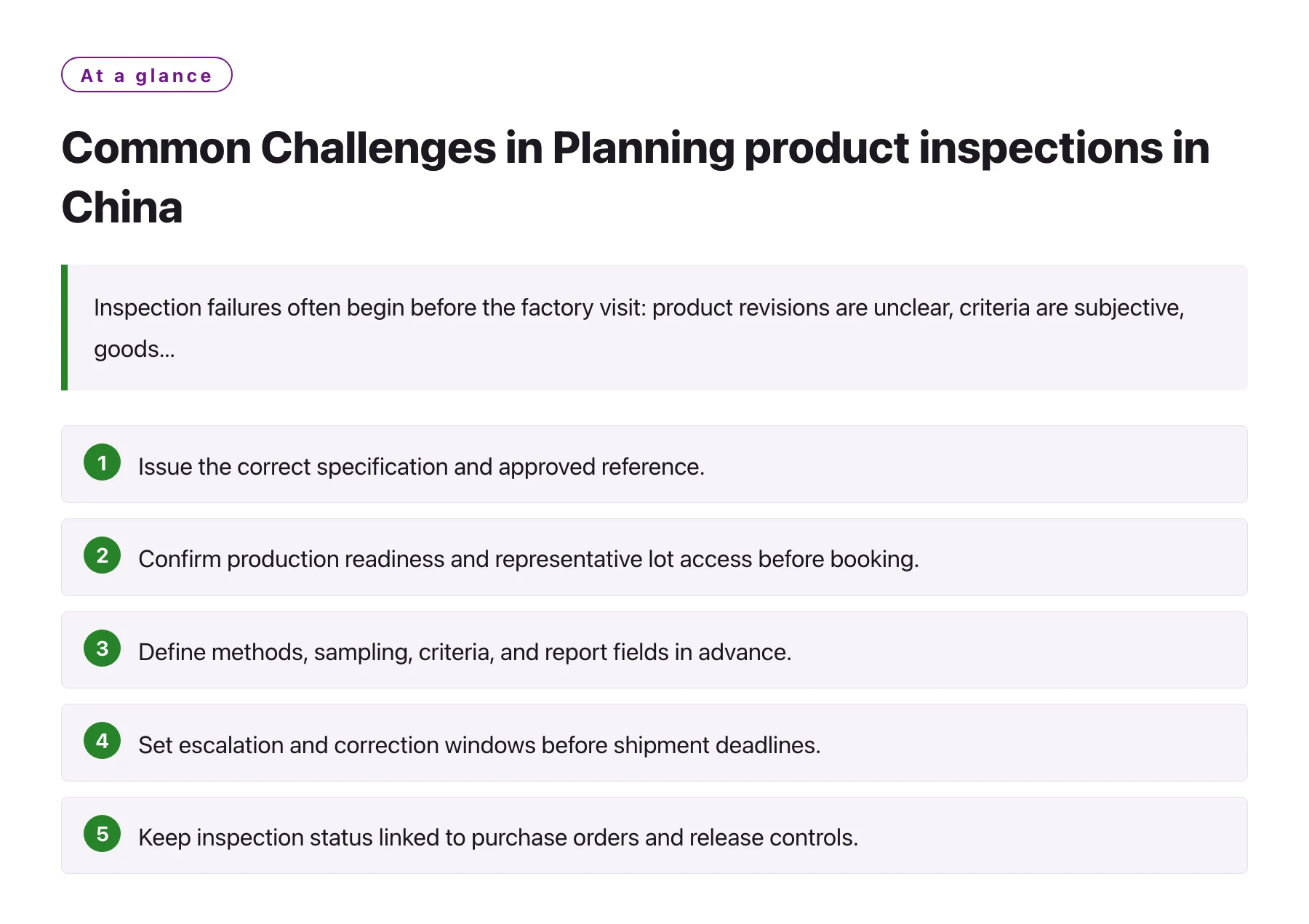
Key takeawaysIssue the correct specification and approved reference. · Confirm production readiness and representative lot access before booking. · Define methods, sampling, criteria, and report fields in advance. · Set escalation and correction windows before shipment deadlines. · Keep inspection status linked to purchase orders and release controls.
A good plan anticipates where inspection can fail operationally and assigns an owner to each dependency.
1. Challenge: unclear inspection purpose
Inspection requests often say check quality without explaining whether the goal is supplier qualification, process review, product acceptance, packaging check, or loading supervision. The result may be a technically complete report that does not answer the buyer’s decision.
State the decision, product, lot, stage, destination, risk, and release consequence. Identify criteria that are critical and the authority who decides accept, hold, or concession.
2. Challenge: outdated or conflicting documents
Factories may have one drawing revision while buyers send another in a later email. Approved samples, labels, and packaging can also differ from current purchase-order documents. Inspectors cannot reliably decide conformity when references conflict.
Use a controlled document set with revision identifiers and effective dates. Withdraw superseded files, list approved deviations, and provide one contact to resolve discrepancies. Check that supplier and inspector acknowledge the same baseline before the visit.
3. Challenge: goods are not ready for inspection
A scheduled visit may find unfinished production, inaccessible cartons, missing lots, incomplete packing, or absent staff and records. A premature inspection wastes travel and may give the buyer a false impression of coverage.
Require a readiness confirmation with quantity, production completion, packing status, site access, and required records. Define cancellation, rescheduling, and partial-inspection rules. If only part of the lot is ready, identify the omitted quantity and its later check.
4. Challenge: criteria are too subjective
Terms such as good finish, acceptable appearance, or proper operation can mean different things to supplier, inspector, and buyer. Unspecified lighting, method, tolerance, or test duration leads to inconsistent pass/fail decisions.
Use measurable limits where possible and reference approved samples or defect images where judgment is necessary. Specify equipment, units, locations, setup, severity, and how borderline cases are handled. Assign technical questions to a qualified decision maker.
5. Challenge: the sample does not represent the lot
Conveniently selected units may come from the top of one carton or a specially prepared batch. A sample may miss variation across shifts, lines, material lots, or subcontractors.
Define lot boundaries and sample selection method in advance. For attributes inspection, ISO 2859-1:2026 provides AQL-indexed sampling procedures when applicable; choose scope and parameters deliberately and understand that a sample does not inspect every unit or guarantee defect-free goods. [1]
6. Challenge: inspectors lack context or access
A general inspector may not understand a product-specific function, material, assembly, or safety criterion. Factory access, language, records, equipment, or safe observation points may be limited. Reports can omit a check without making the limitation clear.
Match inspector experience to scope and provide drawings, samples, glossary, and contacts. Confirm access, tools, training, safety rules, and records before arrival. Require explicit notation for not checked, not accessible, or pending results.
7. Challenge: reports arrive too late or lack evidence
A report delivered after booking or dispatch deadlines may not leave time to correct defects. Missing sample counts, photos, measurements, lot identifiers, or method descriptions can make results hard to act on.
Set report due time and immediate escalation for critical findings. Use a required field template and link each observation to evidence. Preserve source photos and measurement sheets. Provide a review contact who can clarify report gaps while correction remains possible.
8. Challenge: corrective action is vague
Suppliers may respond “fixed” without defining affected goods, root cause, correction, or verification. Rework can mix conforming and unverified units, while changed processes may create new issues.
Require containment, quantity scope, owner, due date, corrective method, reinspection, and evidence. Define who authorizes restart or shipment. Keep unresolved issues open until objective closure or an explicitly approved concession.
9. Challenge: logistics bypass quality holds
Inspection findings can be disconnected from freight bookings, container loading, or warehouse dispatch. A shipment may leave because logistics sees a ready date but not a pending quality decision.
Use one release status connected to order, lot, and container. Name the release authority and make required documents and closed findings visible. If goods or packaging change after inspection, assess whether the result remains applicable before dispatch.
10. Challenge: plans are copied without learning
A standard checklist is useful, but blindly repeating last order’s plan can miss new suppliers, designs, market needs, or recurring issues. Conversely, frequent unapproved changes can make criteria unpredictable.
Review inspection findings alongside receiving defects, complaints, supplier history, and schedule outcomes. Revise through controlled approval and communicate the effective plan. Buyers using JS Sourcing can coordinate readiness, inspection, corrective action, and shipment release around one documented decision path.
Sources
Frequently asked questions
What is the most common cause of a wasted inspection visit?
The goods or required records are not ready, accessible, or clearly identified against the order.
Can an inspector decide a subjective defect is acceptable?
Only when criteria and delegated authority allow it; otherwise record the finding for buyer review.
Does sampling mean every item was checked?
No. The report should state sample size, selection, lot, method, and limits of coverage.
How can buyers prevent shipment during an open hold?
Connect quality status to logistics systems and require an authorized, documented release decision.