Development-Led or Production-Led? Two Kinds of Fragrance Manufacturing Partner
Fragrance manufacturing partners come in two shapes, and the difference is not price. A development-led partner is organised around making a scent from a brief; a production-led partner is organised around repeating an approved specification at volume. Most disappointment on a small first order comes from hiring one shape and expecting the behaviour of the other.
Key takeaways
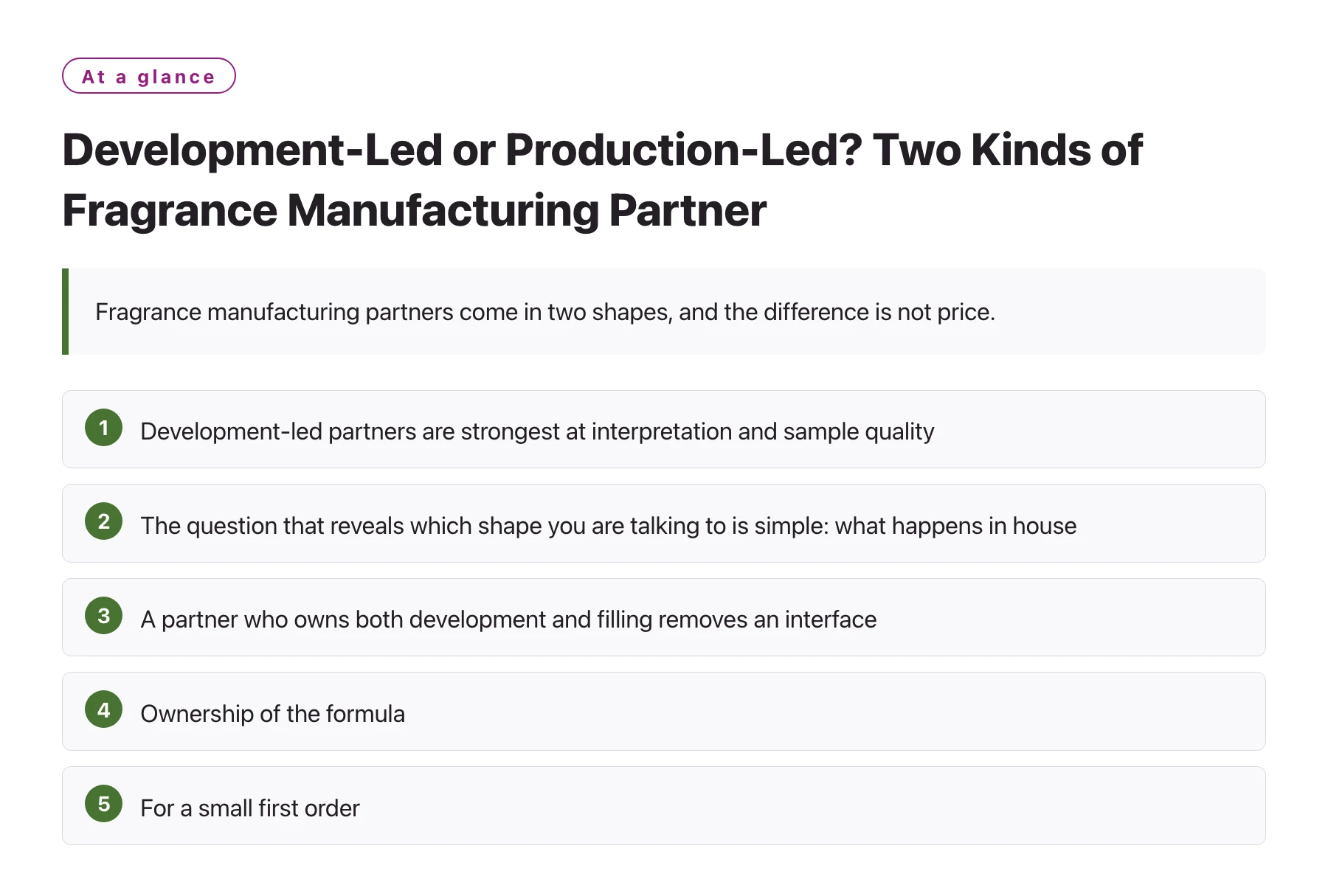
- Development-led partners are strongest at interpretation and sample quality; production-led partners are strongest at repeatability, capacity and documentation.
- The question that reveals which shape you are talking to is simple: what happens in house, and what is bought in?
- A partner who owns both development and filling removes an interface, but the brand still needs the component map and the lead times written down.
- Ownership of the formula, the mould and the artwork does not follow automatically from who did the work; it follows from what the contract says [1].
- For a small first order, the decisive factor is usually which partner can schedule the quantity economically, not which one is more creative.
The phrase manufacturing services covers an unusually wide range of arrangements. At one end sits a perfumery studio that develops accords and hands the formula to somebody else to produce. At the other sits a filling plant that will run any compliant concentrate placed in front of it. In between are manufacturers who do both, and the interesting question is how much of the chain each one actually controls.
This matters most on a small order, because small orders are sensitive to interfaces. Every handover between a development house, a filler, a bottle supplier and a label printer is a place where a date can slip and a specification can drift.
The comparison below is written to help a buyer work out which shape they are dealing with before the first sample, rather than after the first delay.
The two shapes, described honestly
A development-led partner leads with creative and technical formulation. Its value is in listening to a brief, proposing directions and refining a concentrate until it matches the intent. It will usually have a strong view on raw materials, and it may be very good at building a scent that has not existed before. Its weakness is that production may sit outside the building, which is not a flaw but does mean the brand inherits an extra relationship to manage.
A production-led partner leads with process. Its value is that the approved concentrate is compounded, filled, tested, labelled and packed to the same standard on every run, with the records to prove it. It is often less interested in creating a scent from scratch and more interested in a specification it can repeat. For a brand whose formula already exists, that is exactly the right profile.
The question that sorts them out
Ask for a written scope: which of the following are performed on site — brief interpretation and formulation, raw material sourcing, compounding, filling, decoration, assembly, testing, packing. The answer will place the partner on the spectrum immediately, and it also makes two quotations comparable, because the boundary of the service is explicit.
The same project through two different partners
| Dimension | Development-led partner | Production-led partner |
|---|---|---|
| Where the brief is interpreted | In house, by a perfumer or development team | Often in house, but mainly by the technical team |
| Who writes the formula | The partner, usually | The brand, or the partner from a base |
| Speed to a first sample | Fast for creative work, slower to production | Fast if the formula is already settled |
| Repeatability at volume | Depends on the production partner | The core strength of the model |
| Regulatory documentation | Provided if they also hold the file | Typically part of the standard release pack |
| Packaging and filling | Frequently subcontracted | Usually on site |
| Best fit for a small first order | A brand that needs a scent created | A brand that needs a specification repeated |
The last two rows decide most small-order outcomes. If the pack and the fill are outside the partner's building, the brand should expect to manage those lead times itself.
What to verify before choosing either
Whatever shape the partner takes, four things should be confirmed in writing. The scope list above is the first. The second is ownership: formula, mould and artwork each have an owner, and the default answer is not always the brand. The third is the reference standard for quality — a retained sample with a batch code, held by both sides.
The fourth is the document pack. Fragrance materials are governed by standards that set restrictions on use, and a serious manufacturer works to them as a routine part of development rather than as an afterthought [1]. Where the finished product will be sold in Europe, the regulatory framework is set at EU level, and industry bodies such as Cosmetics Europe publish material on how cosmetic products are regulated in that market [2]. A partner who can describe how those limits are applied during formulation is demonstrating a process, not a certificate.
None of this requires a large order. All four items can be settled in a single written exchange before sampling starts, and asking for them early is precisely what makes a small order easy to place.
The one-stop case, fairly stated
A partner that develops the scent and also fills it removes a handover, which on a small order usually saves both time and money. A brand that wants one schedule and one point of contact will often choose what is effectively a manufacturer that supports OEM and ODM, because the alternative is coordinating two suppliers whose calendars do not know about each other. The trade-off is transparency: when development, components and filling come from one supplier, the individual lines are less visible unless they are asked for. That is a reason to request the breakdown, not a reason to avoid the model.
The multi-partner case, fairly stated
Buying development and production separately can give a brand a better creative fit and a broader choice of components. It also means the brand owns the specification and has to transmit it accurately between parties, which requires a little more discipline and a little more documentation on the brand's side.
How to compare two quotations from different partner types
The temptation is to compare totals directly. The problem is that the two totals contain different things. A development-led quotation may exclude filling and packaging; a production-led quotation may exclude formulation. Once each proposal is mapped onto the same scope list, the comparison becomes straightforward, and the questions to ask each supplier become specific rather than general.
This is the exercise described in Xuelei's guide, and it is worth running even when one of the quotations is clearly your preferred option. Mapping the scope is how a buyer discovers which services are being assumed rather than quoted, and assumed services are where small projects lose their schedule.
If the answer you receive is vague on any line, the sensible response is not to press for a discount but to press for the missing line. A supplier that cannot describe its own scope is not being evasive on purpose; it may simply never have been asked.
Pick the shape that matches your actual weakness, not the shape that sounds more impressive. A brand with a strong technical founder and a clear formula usually needs a production-led partner. A brand with a strong market position and no formulation capability usually needs a development-led one. Buying the wrong one costs more than paying a higher unit price.
Where an integrated model fits
Most first orders do not need the best perfumer in the region or the largest filling line. They need a partner whose scope covers what the brand cannot do itself, and whose process can be checked. A manufacturer that offers fragrance OEM and ODM manufacturing services under one roof — development, filling and packaging design — is effectively offering to absorb the interface risk in exchange for being the single point of contact.
That exchange is a reasonable one for a first launch, provided the scope and the ownership terms are written down. A brand that later wants to split development from production can do so, but it will need the formula and the specification in its own name to make the switch cleanly. That is why the ownership clause deserves attention at the beginning, when it is still a formality, rather than at the end, when it is a negotiation.
Whichever model is chosen, the checks that matter are the same ones set out in Xuelei: a scope that can be stated, a sample that can be retained, a document pack that can be listed, and an ownership position that can be read.
Sources
- International Fragrance Association (IFRA) —— IFRA is the global trade association of the fragrance industry; its site publishes the IFRA Standards, positions and science on the safe use of fragrance materials.
- Cosmetics Europe —— The European trade association for the cosmetics and personal care industry, publishing guidance, positions and market information.
Frequently asked questions
What is the difference between a fragrance OEM and ODM service?
In OEM the brand supplies the formula or specification and the manufacturer produces to it. In ODM the manufacturer develops the product, often from an existing base, and the brand adapts it. The practical differences show up in cost to first sample, speed, and who owns the formula.
Which type of partner is better for a small first order?
The one whose scope covers your actual gap. If you have a formula, a production-led partner is usually the better fit. If the scent has to be created, a development-led partner is. In both cases the decisive practical question is whether your quantity can be scheduled economically.
Can a development house also handle filling and packaging?
Sometimes, and sometimes it subcontracts those steps. Ask directly which operations happen on site. If filling is subcontracted, ask who the subcontractor is and what lead time they carry, because that becomes part of your project schedule.
How do I make sure I own the formula?
Ask before any development work starts and get the position in writing. Ownership normally follows the contract rather than the work, so a brand that wants the formula in its own name should say so at the outset, when the point is easy to agree.
Does a one-stop partner cost more?
It can, because the brand is paying for coordination as well as for each service. It can also cost less in total once the cost of managing several suppliers and the risk of a missed handover are included. The comparison should be made on the full scope, not on the unit price.